
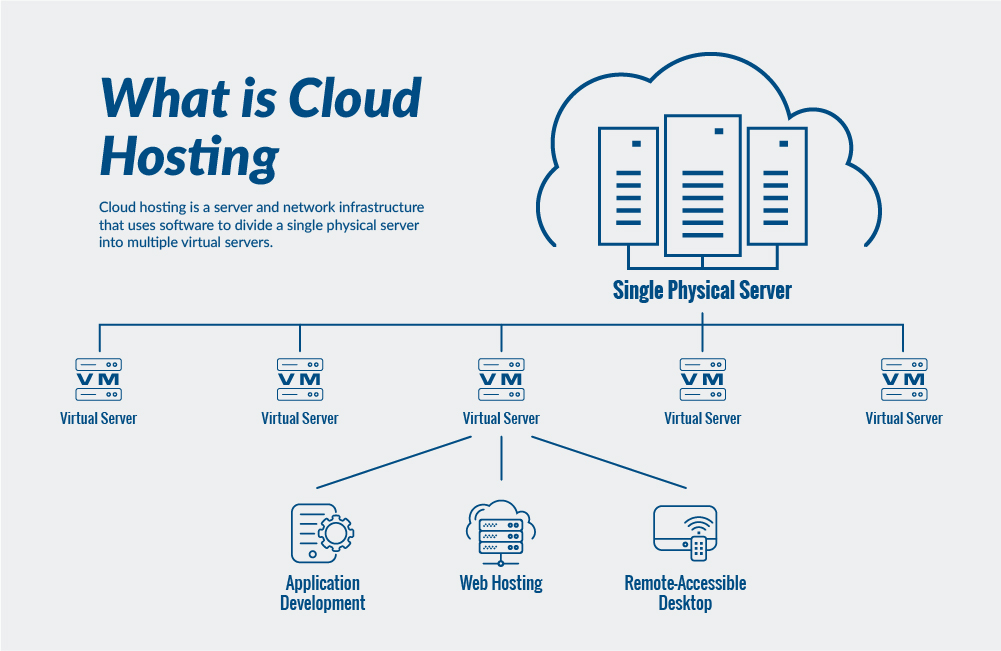
Cloud hosting refers to a type of web hosting service that utilizes cloud computing technology to deliver resources and services to websites or applications. Instead of relying on a single physical server, cloud hosting operates across a network of interconnected virtual servers that are hosted in various data centers. This distributed infrastructure allows for greater flexibility, scalability, reliability, and performance compared to traditional hosting solutions.
Here are some key benefits of cloud hosting:
- Scalability: One of the most significant advantages of cloud hosting is its scalability. With cloud hosting, resources such as CPU, RAM, and storage can be dynamically scaled up or down based on demand. This means that websites or applications experiencing sudden spikes in traffic can easily accommodate increased demand without experiencing downtime or performance issues.
- High Availability: Cloud hosting offers high levels of availability and uptime. Since cloud hosting relies on a network of servers, if one server fails, another server can quickly take over, ensuring that websites or applications remain accessible to users. This redundancy minimizes the risk of downtime and ensures continuous availability.
- Flexibility: Cloud hosting provides flexibility in terms of resource allocation and configuration. Users have the ability to customize their hosting environment and allocate resources based on their specific requirements. This flexibility allows users to optimize performance and cost-effectiveness based on their changing needs.
- Cost-Effectiveness: Cloud hosting is often more cost-effective than traditional hosting solutions, particularly for businesses with fluctuating traffic levels. Since cloud hosting providers typically operate on a pay-as-you-go model, users only pay for the resources they consume. This eliminates the need for upfront capital investment in hardware and allows for greater cost control.
- Performance: Cloud hosting offers excellent performance due to its distributed nature and the ability to leverage resources from multiple servers simultaneously. This ensures fast response times and low latency, resulting in a seamless user experience for website visitors or application users.
- Security: Cloud hosting providers implement robust security measures to protect data and infrastructure from cyber threats. These measures may include firewalls, encryption, intrusion detection systems, and regular security updates. Additionally, data stored in the cloud is often backed up and replicated across multiple locations, reducing the risk of data loss due to hardware failure or disaster.
- Global Reach: Cloud hosting enables businesses to reach a global audience by allowing them to deploy their websites or applications in data centers located in different geographic regions. This distributed infrastructure reduces latency and ensures optimal performance for users located in various locations around the world.
Overall, cloud hosting offers numerous benefits, including scalability, high availability, flexibility, cost-effectiveness, performance, security, and global reach. These advantages make cloud hosting an attractive option for businesses and organizations seeking a reliable, scalable, and cost-effective hosting solution for their websites or applications.
Benefits of Cloud Hosting
1. Flexible Pricing Structure
In most other styles of hosting you pay a monthly rate regardless of whether to not you utilize all of the server resources. With cloud hosting, you only pay for what you use.
So, if you’re expecting a post to go viral, or your site is receiving an unusually large amount of traffic, you don’t have to completely upgrade your package. All you have to do is scale your resources up during the traffic surge and down once traffic levels return to normal. Instead of having to pay for high hosting fee across the board your pricing matches the total amount of server resources you’re using.
2. Very Easy to Scale Server Resources
With cloud hosting scaling your server resources couldn’t be easier. For most cloud servers you’ll have access to an intuitive site management dashboard that lets you view your site’s performance in real time. You can scale server resources up or down on the spot without having to wait for approval from your hosting provider.
3. Redundant Server Environment
With most types of hosting your site lives on a single server. If something were to happen to that server, then your site would go offline and you wouldn’t be able to get back online until that server is fixed. When your hosting is redundant a site backup will take over your existing site within seconds. However, not all redundancy is created equal. With cloud hosting, you’ll have a concurrent live version of your website that your host can load immediately.
4. High Uptime and Availability
If you’re using any kind of traditional hosting your site’s uptime depends upon the physical server environment. If it goes offline, then so does your site. Unless you’re utilizing a CDN, which can help to reduce your site’s overall downtime.
Cloud hosting has high uptime built into its structure. Since your site will be virtually using the resources of multiple servers, you can simply be transferred to another server if one goes offline or is experiencing technical issues. Plus, with your ability to scale server resources on demand your site won’t go offline from an unexpected traffic surge.
5. Speedy Server Setup Process
You can deploy a cloud hosting server in record time. Unless you’re signing up for a beginner shared hosting package, it might take some time to deploy your web server. This can be a hassle if you need your site online quickly, or you’re doing a host migration and you’re stuck waiting for the server to be ready.
6. Safety From Server Hardware Issues
With cloud hosting your site is isolated from any physical server issues including hacking, hardware failure, or system overload. When a physical server is compromised or experiencing an issue, you can simply utilize the physical resources of another server – all without having any downtime.
7. Faster Website Speed and Performance
Most cloud servers can offer you blazing fast speeds. In addition to being able to effortlessly increase your site’s capacity, cloud hosting also allows for easier load balancing between multiple server environments, which can help to put much less strain on a single server’s resources.
Of course, the server hardware foundation will also influence the speed of your site, so look for a cloud host that has multiple caching layers, premium server hardware, and low-density servers.
8. Works Great for Sites With Scalable Traffic
If your traffic levels are up and down, then it’s going to be hard to find a host that’ll give you the best value for your money. With cloud hosting, you have the ability to easily scale your server resources up and down on an as-needed basis. It’s very difficult to find this level of scalability with any other style of hosting.
9. Simple Server Management Dashboard
In the past cloud servers were a little difficult to manage and it required technical expertise to manage and scale your server effectively. But, with today’s cloud hosting you can easily keep track of your hosting and scale it on demand via an intuitive dashboard. You don’t need to have a technical background just to run your cloud server.
10. Decrease Your Overall Environmental Impact
If you’re a company or individual who’s concerned about their environmental impact, but need a hosting solution that goes beyond traditional shared hosting, then cloud hosting could be exactly what you’re looking for. With cloud hosting, you’re utilizing fewer overall datacenters and are only using the server resources you actually require at the moment. By streamlining your resource and data use you’re creating less of an environmental impact.