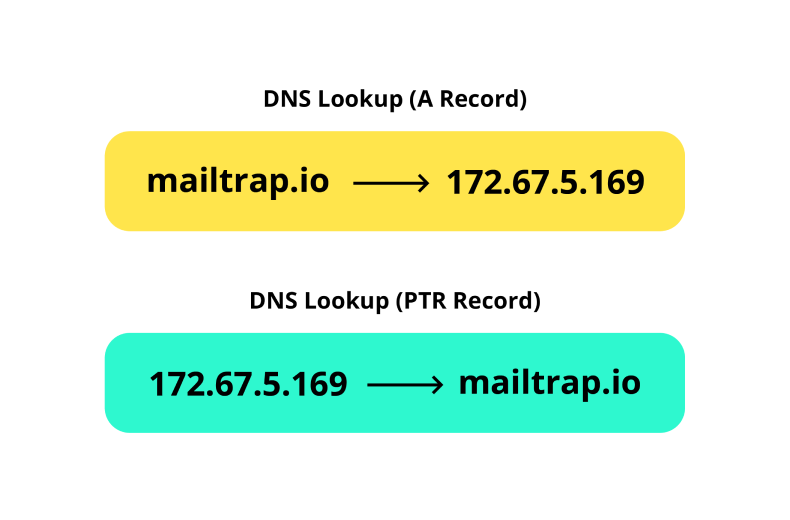

What is PTR record – A PTR (Pointer) record, also known as a Reverse DNS (rDNS) record, is a type of Domain Name System (DNS) record used to map an IP address to a domain name. While traditional DNS records map domain names to IP addresses (forward DNS resolution), PTR records perform the reverse process by associating an IP address with a domain name.
What is a PTR Record?
Put simply, a PTR record is the reverse of an A record. PTR records serve as an identification factor and confirm that an IP address points back to the host.
PTR records are straightforward and contain your hostname, IP address, and time to live (TLL), which is how long the information stays before being discarded.
Do I Need PTR Records?
The short answer is yes. PTR records can save time and prevent problems. Email is an integral part of business, and it’s crucial to prevent any issues before they arise. Google recommends PTR records as part of its best practices.
Not only do PTR records help make the email process smoother by providing that verification, but it also provides credibility to users.
You never want your emails to bounce back or get sent to spam. It harms your trustworthiness, and your customers will wonder why your emails didn’t reach their inboxes.
The good news is PTR records are simple to configure.
Hosting platforms give you control of your DNS records. Bluehost provides easy to manage DNS records on the cPanel of select hosting plans.
You can also make sure that everything is set up correctly with tools like MX Toolbox.
Pointer records are used during reverse DNS lookup, and they connect IP addresses to hostnames.
PTR records are used for verification. Mail servers use them to make sure emails come from the locations they claim to come from. And the majority of email servers search PTR records in their anti-spam check.
DNS is a vital part of making sure your website and traffic run without issue. Set your website up for success by configuring all the essential DNS records.
What is PTR record – Key points about PTR records:
- Reverse DNS Lookup:
- PTR records facilitate reverse DNS lookups. When you have an IP address and want to find the corresponding domain name, you perform a reverse DNS lookup using the PTR record.
- IP Address to Domain Mapping:
- The PTR record provides a way to map an IP address to its associated domain. This is particularly useful for email servers and other services that may perform reverse DNS lookups to verify the legitimacy of the connecting server.
- Email Server Authentication:
- PTR records play a crucial role in email authentication. Many email servers use reverse DNS lookups to verify that the IP address of the sending server has a valid PTR record. A mismatch between the PTR record and the sending server’s hostname can lead to email deliverability issues.
- Format of PTR Records:
- The format of a PTR record is the reverse of a standard DNS record. Instead of mapping a domain to an IP address, it maps an IP address to a domain. For example, if the IP address is “192.168.1.1,” the corresponding PTR record might be “1.1.168.192.in-addr.arpa.”
1.1.168.192.in-addr.arpa. IN PTR example.com.
- The domain name associated with the IP address is specified at the end of the PTR record.
- Configuring PTR Records:
- PTR records are typically managed by the entity that controls the IP address range. This is often the Internet Service Provider (ISP) or the organization that owns the IP addresses. The process of configuring PTR records involves contacting the entity responsible for managing the IP address space and providing them with the desired domain name for reverse DNS resolution.
- Importance for Network Security:
- PTR records can be used as a security measure to identify legitimate servers and prevent spoofing. Verifying that the PTR record matches the expected domain helps ensure the authenticity of network communication.
- PTR records can be used as a security measure to identify legitimate servers and prevent spoofing. Verifying that the PTR record matches the expected domain helps ensure the authenticity of network communication.